
You Owe 18% GST on Your Claude, Cursor and AWS Bills: Reverse Charge for Indian Freelancers
If you have a GSTIN and buy software from a foreign vendor, the missing GST on that invoice isn't a discount — the liability moved to you. What reverse charge means, a real self-invoice PDF you can download, what three years of ignoring it costs, and how to fix old periods without losing the credit.

Freelancer for 10+ years with clients in the USA, Australia, Europe, South Africa and India. Built InvoiceRocket to keep his own invoicing, GST and Section 44ADA tracking in order, and to give his CA everything in one place.
I have freelanced in software for years and only ran into this last month, while cleaning up my own books. I have asked a dozen freelancers since. Almost none of them knew.
When you buy from a foreign company — Anthropic, OpenAI, Cursor, Vercel, AWS, Notion, Figma, any of them — and the invoice shows no GST, that is not because the transaction is GST-free. It is because the liability moved to you. You are expected to pay 18% IGST on that invoice yourself, issue a self-invoice for it, and report it in your GSTR-3B.
Most of us just don't. The invoice says $20, we pay $20, file it away, move on.
TL;DR. If you hold a GSTIN, imported services are taxed in your hands under reverse charge at 18% IGST, paid in cash — you cannot discharge it from your credit balance. Issue a self-invoice under section 31(3)(f) within 30 days, report the value in GSTR-3B table 3.1(d), and take the credit back in 4(A)(2) "Import of services" — not 4(A)(3), which is for reverse charge on Indian suppliers. Done on time it is cash-neutral. Done late it costs 18% interest per annum from each original due date, plus a 10% penalty once a notice is issued. Circular 211/5/2024-GST means the credit survives even for old periods, because the ITC clock runs from the date you issue the self-invoice.
This is an explainer, not professional tax advice. I am not a chartered accountant. GST rules change — confirm your own position with your CA, particularly if you export under LUT.
What reverse charge actually means for a $20 invoice
Normally the supplier collects GST from you and pays it to the government. Reverse charge flips that: for certain supplies the recipient assesses and pays the tax directly. Import of services is one of them.
The foreign vendor has no Indian GST registration and no way to collect Indian tax from you, so section 5(3) of the IGST Act puts the liability on you as the recipient. The place of supply is your location, which makes it an inter-state supply, which makes it IGST at 18%.
Two consequences that trip people up:
You pay it in cash. Reverse-charge liability cannot be set off against your existing input tax credit. It goes through the electronic cash ledger, via challan. Sitting on a large credit balance does not help you here.
You have to create the document yourself. There is no vendor tax invoice with GST on it to attach to your books, so section 31(3)(f) requires you to raise a self-invoice — a tax invoice you issue to yourself, on behalf of the supplier. Rule 47 gives you 30 days from receipt of the supply.
Does this apply to you?
People get this wrong in both directions.
If you have a GSTIN — yes, this is you. It does not matter that you are on section 44ADA presumptive taxation. It does not matter that you never claim expenses. Income tax and GST are separate statutes, and the presumptive scheme has no bearing on a GST liability. If you handed your GSTIN to Anthropic or OpenAI so they would stop charging you 18%, you are precisely the person this applies to — that is what giving them the GSTIN did.
If you are not GST-registered at all — below the ₹20 lakh services threshold, ₹10 lakh in special category states — this is not you. In the language of the law you are a "non-taxable online recipient", and since the October 2023 amendments the foreign vendor is required to register in India and charge you GST directly. That is why you may have noticed Anthropic and OpenAI showing 18% on Indian invoices now. Nothing for you to do.
One caveat worth naming: that clean split holds for digital services delivered over the internet. If an unregistered person imports a non-digital service — a foreign consultant on a call, say — section 24(iii) compulsory registration can bite. Worth a question to your CA if that is your situation.
So the people actually exposed are the ones who gave these vendors a GSTIN to get the tax taken off the invoice.
What a self-invoice actually looks like
This is the part nobody shows you. Here is a real one, generated from my own books — a single GitHub Copilot seat billed at USD 19.
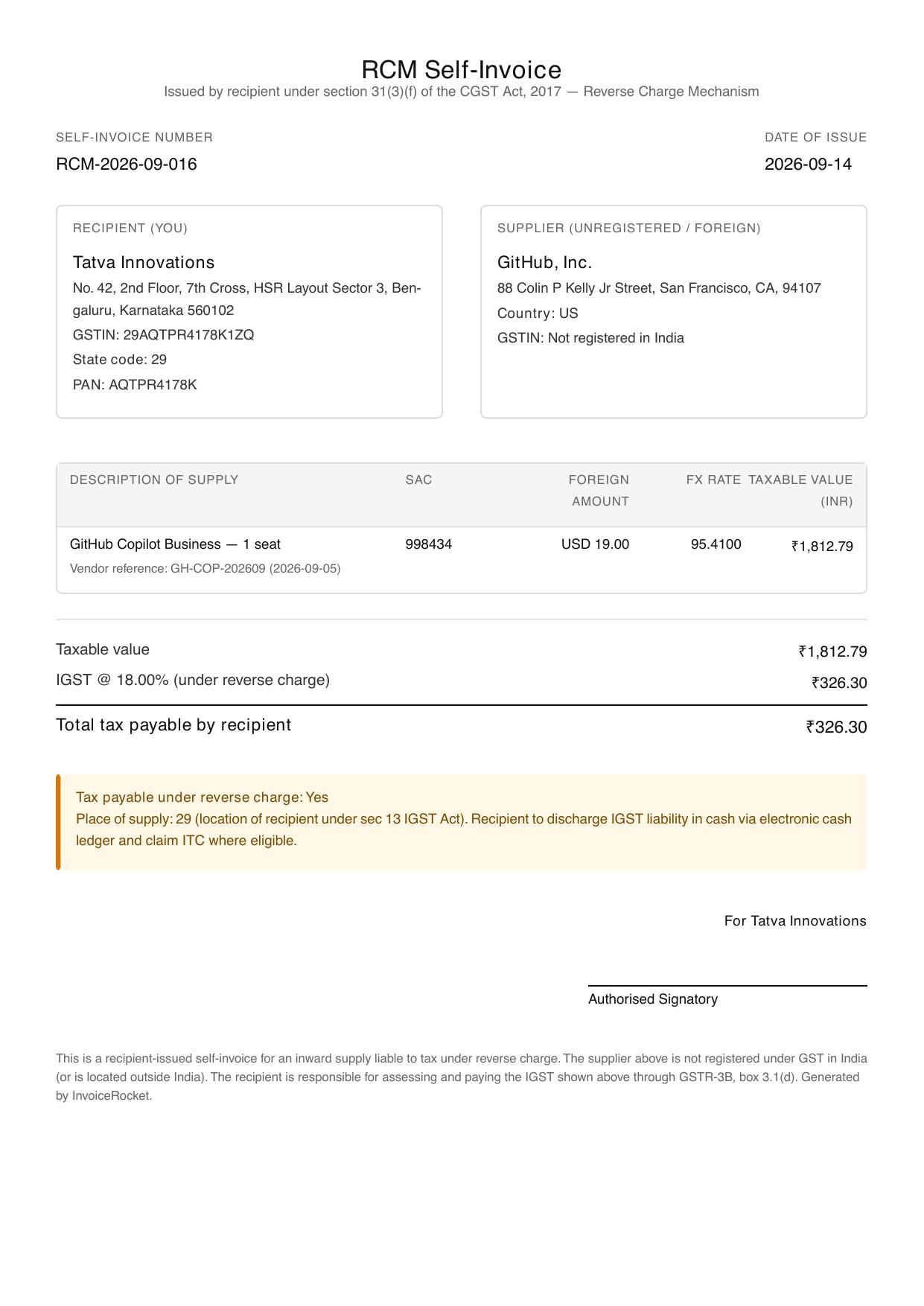
Download this self-invoice as a PDF if you want a template to hold against your own.
The fields that have to be there:
| Field | On the sample | Why |
|---|---|---|
| Distinct serial number | RCM-2026-09-016 | A separate series from your sales invoices, consecutive, per financial year |
| Date of issue | 2026-09-14 | Within 30 days of the supply (Rule 47) — here the bill was 5 September |
| Your details as recipient | Name, address, GSTIN, state code | You are the one liable |
| Supplier name and address | GitHub, Inc., 88 Colin P Kelly Jr Street, San Francisco — "Not registered in India" | Identifies whose supply you are self-assessing |
| Description and SAC | Copilot Business, 998434 | 998434 is on-line software supply; cloud infrastructure is usually 998315 |
| Taxable value in INR | ₹1,812.79 at 95.41 | The foreign amount converted at the rate on the invoice date |
| IGST and rate | 18%, ₹326.30 | Paid in cash, claimed back as credit |
| Reverse charge declaration | "Tax payable under reverse charge: Yes" | Rule 46(p) requires it on the face of the document |
| Signature | Authorised signatory | Rule 46(q) |
Note the ₹326.30 on a USD 19 subscription. The amounts are small individually. That is exactly why three years of them go unnoticed.
One more thing that catches people: report the self-invoice serial numbers in GSTR-1 Table 13, "Documents issued during the tax period", under invoices for inward supply from unregistered persons. It is a disclosure, not a tax, and it is routinely skipped.
Doing it on time costs you nothing
Here is the part that makes the whole exercise feel absurd once you understand it.
You pay 18% in cash. You claim the same 18% straight back as input tax credit in the same return. Net cash impact: zero. It is a bookkeeping entry, not an expense.
| Step | Where | Amount on a ₹1,812.79 bill |
|---|---|---|
| Declare the inward supply | GSTR-3B 3.1(d) | ₹1,812.79 taxable value |
| Pay the tax in cash | Challan → electronic cash ledger | ₹326.30 |
| Take the credit back | GSTR-3B 4(A)(2) — Import of services | ₹326.30 |
| Net | ₹0 |
Get the ITC row right. The credit for imported services goes in 4(A)(2), not 4(A)(3). Table 4(A)(1) is imported goods, 4(A)(2) is imported services, and 4(A)(3) is reverse charge on supplies from Indian suppliers — an advocate's fee, GTA freight. Putting it in the wrong row usually will not cost you the credit, but it is a mismatch you will be asked to explain.
One real exception. If you export under an LUT, your output tax is nil, so the credit has nothing to set off against. It accumulates in your electronic credit ledger instead of being consumed. You are not out of pocket permanently — you claim it as a refund of unutilised ITC under section 54 via RFD-01 — but it becomes a cash-flow question and a quarterly chore rather than a wash. That is the genuinely messy case and the one worth a proper conversation with your CA.
What it costs if you don't
Interest under section 50 runs at 18% per annum from each original due date. Not a one-time 18% — it compounds against you month after month, on every month's missed liability separately.
Take a modest ₹15,000/month spend on foreign tools, ignored for three years:
| Amount | |
|---|---|
| Tools bill | ₹15,000/month |
| IGST @ 18% | ₹2,700/month |
| Tax across 36 months | ₹97,200 |
| Interest @ 18% p.a., accrued from each due date | ₹26,973 |
| Penalty @ 10% of tax, if a notice lands first (s.73) | ₹9,720 |
| Gross exposure | ₹1,33,893 |
| Less: the tax itself, recoverable as ITC | (₹97,200) |
| Net cost of having waited | ₹36,693 |
The ₹97,200 was never really the cost — you get that back as credit. The ₹36,693 of interest and penalty is pure loss, and it is entirely a function of delay. On a ₹15k/month tools bill. Scale that to a studio running AWS and a seat of everything and the number stops being a rounding error.
And it does surface. This is not a liability that hides well:
- Since October 2023, foreign digital service providers file GSTR-5A with a dedicated table for B2B supplies to registered Indian recipients. Your GSTIN sits inside Anthropic's filing with GSTN.
- Your outward remittances are reported separately through Form 15CA and your bank's own reporting.
- Matching either against a nil figure in your 3.1(d) is a database query, not an investigation.
The department has been running exactly this kind of return-versus-third-party-data matching to generate scrutiny notices. I have written up a ₹15.77 lakh DRC-01A I received on a different issue — a missing LUT — and the mechanism was identical: an officer comparing one number in my return against data they already held.
The good news if you're already late
You do not lose the credit. This is the single most important thing to know before you panic about old years.
Section 16(4) puts a time limit on claiming input tax credit, and the natural fear is that credit on a FY 2023-24 subscription is simply dead. CBIC Circular 211/5/2024-GST (26 June 2024) clarified that for reverse-charge supplies received from an unregistered or foreign supplier, the relevant financial year for the section 16(4) limit is the year in which you issue the self-invoice — not the year the supply happened.
So you can self-invoice old periods today and still take the credit. You will owe interest on the delayed payment, but the credit itself is not lost.
Which is the argument for fixing it yourself rather than waiting. Pay voluntarily before a notice is issued and there is no penalty at all — section 73(5) closes the proceeding on payment of tax with interest. Wait for the notice and you add 10%.
How to fix past years
- Pull every foreign vendor invoice with no GST on it, financial year by financial year. Bank and card statements are the reliable source; vendor emails go missing.
- Issue a self-invoice for each, under section 31(3)(f), with the fields in the table above and a distinct serial series.
- Convert at the rate applicable on the invoice date, and keep the rate on the document. Do not use today's rate for a 2023 bill.
- Pay 18% IGST in cash. For the current period this goes through your normal GSTR-3B. For closed periods, use DRC-03 as a voluntary payment.
- Report in GSTR-3B 3.1(d) and claim the credit in 4(A)(2) in the same return.
- Add the serial numbers to GSTR-1 Table 13.
- If you are on LUT, track the accumulating credit and decide with your CA whether to pursue an RFD-01 refund.
Do steps 1 and 2 this week if you do nothing else. The interest clock is the only part of this you cannot undo later.
Frequently asked questions
Do I have to pay GST on Claude, ChatGPT or Cursor subscriptions?
If you hold a GSTIN and the invoice shows no GST, yes — 18% IGST under reverse charge, paid by you in cash and claimed back as input tax credit in the same return. If you are not GST-registered, no: the vendor is required to register in India and charge you GST directly, which is why Indian invoices from Anthropic and OpenAI now show 18%.
Does reverse charge apply if I am on section 44ADA presumptive taxation?
Yes. Section 44ADA is an income tax provision governing how your professional income is computed. GST is a separate statute with separate obligations. Being on presumptive taxation, and never claiming a single expense, has no effect on a reverse-charge liability that arises from holding a GSTIN.
What is a self-invoice and when do I have to issue it?
A self-invoice is a tax invoice you raise to yourself on behalf of an unregistered or foreign supplier, required by section 31(3)(f) of the CGST Act for supplies liable to reverse charge. Rule 47 gives you 30 days from receipt of the supply. It needs its own serial series, your GSTIN, the supplier's details, the SAC, the INR taxable value, the IGST, a "tax payable under reverse charge" declaration and a signature.
Can I pay reverse charge GST using my input tax credit balance?
No. Reverse-charge liability must be discharged in cash through the electronic cash ledger. You cannot offset it against an existing credit balance, however large. You can claim the same amount back as credit immediately afterwards, but the payment leg is cash.
Which GSTR-3B table does reverse charge on foreign software go in?
The taxable value goes in table 3.1(d), "Inward supplies liable to reverse charge". The credit comes back in table 4(A)(2), "Import of services". Do not use 4(A)(3) — that row is for reverse charge on supplies from Indian suppliers, such as an advocate's fees or goods transport agency freight.
I have not paid reverse charge for three years. Have I lost the input tax credit?
No. CBIC Circular 211/5/2024-GST clarified that for reverse charge on supplies from unregistered or foreign suppliers, the section 16(4) time limit for claiming credit runs from the date you issue the self-invoice, not the date of the supply. Self-invoice the old periods now and the credit is still available. You will owe interest at 18% per annum on the late payment.
What is the penalty for not paying reverse charge GST?
Interest accrues at 18% per annum under section 50 from each original due date. If you pay voluntarily before a notice is issued, section 73(5) closes the matter with no penalty. Once a notice is issued in an ordinary (non-fraud) case, the penalty is 10% of the tax or ₹10,000, whichever is higher.
I export under LUT. Is reverse charge still cash-neutral for me?
Not in the same way. You still pay the 18% in cash, and you still get the credit — but with nil output tax there is nothing to set it off against, so it accumulates in your electronic credit ledger. Recovering it means claiming a refund of unutilised ITC under section 54 through RFD-01. Worth planning with your CA rather than letting the balance build for years.
I added automatic self-invoicing to InvoiceRocket after going through this exercise on my own books, which is how I ended up this deep in it.
Mark an expense Import of service (RCM) and the app does the mechanical part: it computes 18% IGST on the INR value at the locked exchange rate, issues a numbered self-invoice on its own RCM- series the moment you save, and files the PDF against the expense. If you record a foreign-currency bill and don't classify it that way, it asks whether you meant to. The GST screen then carries the value into 3.1(d) and the credit into 4(A)(2), warns you before you file if any self-invoice is still missing, and tracks unpaid reverse charge as a running cash backlog with section 50 interest — so the number you owe is on screen rather than accruing quietly.
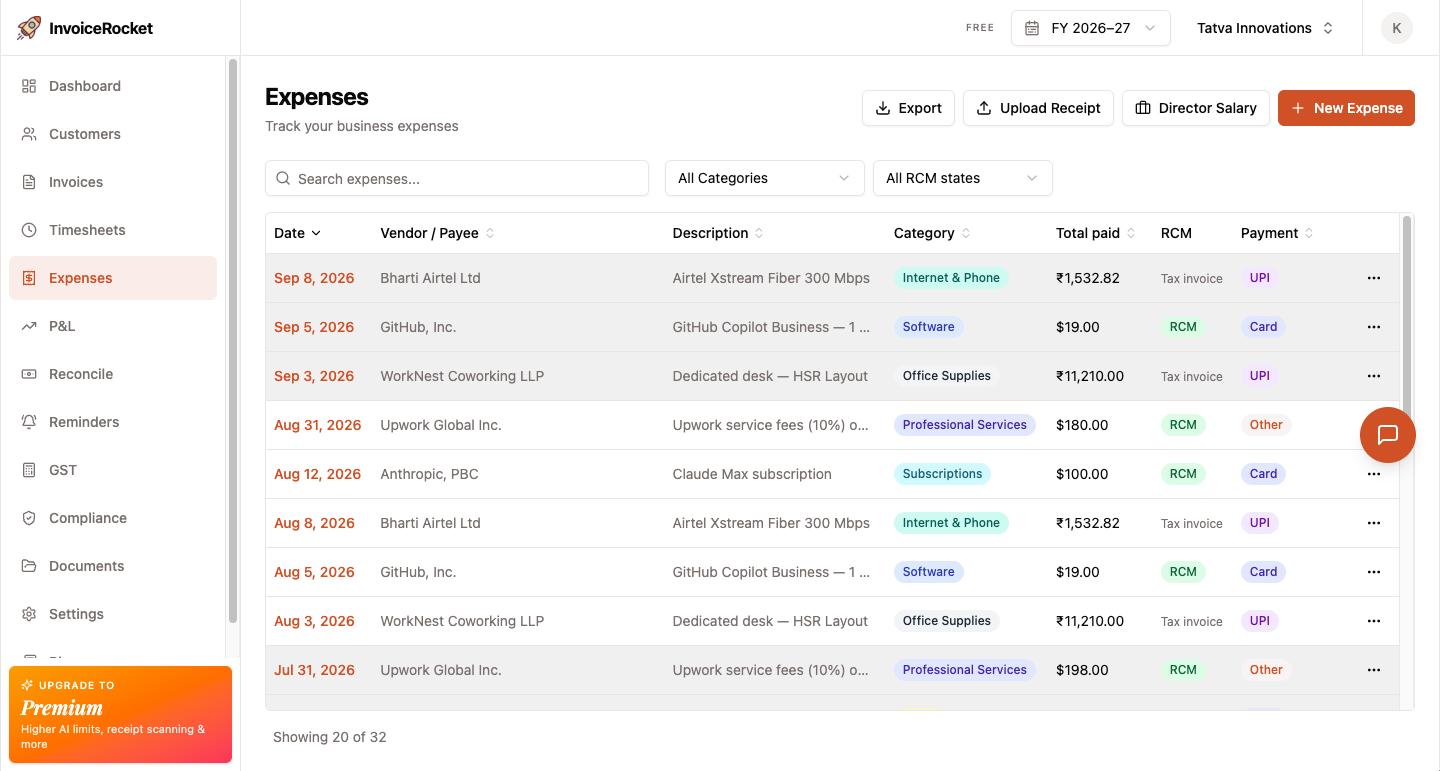
Start tracking reverse charge free. Every foreign vendor bill gets its self-invoice the day you record it, instead of three years of interest later.